
Evergreen vs timely content is one of the most important decisions a personal injury law firm makes when building its online presence. Getting this balance wrong means publishing pages that either go stale quickly or never connect with the people searching for help right now. The right SEO content strategy uses both types, placed deliberately, to keep your website visible, trusted, and competitive all year long.
At Adsurdly, we work directly with personal injury law firms across the USA to build content systems that convert readers into clients. We understand how search engines, AI tools, and real users consume legal content, and how each requires a slightly different approach. If you are new to legal content planning, our legal marketing overview is a good place to start before diving into the tactics below.
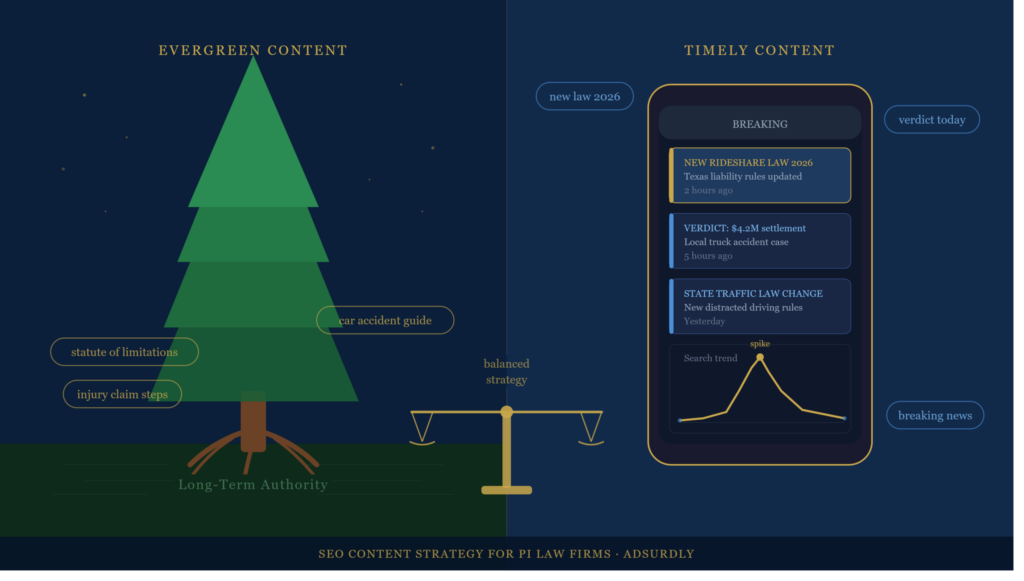
Key Takeaways: SEO Content Strategy for PI Law Firms
- Evergreen content builds long-term authority by answering questions that injury victims repeatedly ask, regardless of the season or news cycle.
- Timely content captures short-term search spikes tied to recent verdicts, law changes, or local incidents that directly affect potential clients.
- A balanced SEO content strategy that combines both types consistently outperforms firms that rely on a single approach.
Benefits of Each Content Type
Why Evergreen Content Is the Foundation of PI Law SEO
Evergreen content covers topics that stay relevant for months or years. Articles like “What to Do After a Car Accident” or “How Long Does a Personal Injury Claim Take?” continue to attract search traffic long after publication. They build the kind of compounding authority that search engines reward with steady, reliable rankings.
For personal injury firms, evergreen content does something equally important: it meets clients where they are emotionally. Someone searching for answers after a traumatic accident needs calm, clear guidance. Evergreen content, written with empathy and real expertise, delivers exactly that. Google itself confirms that content demonstrating experience, expertise, authoritativeness, and trustworthiness (E-E-A-T) is what their systems are designed to prioritize in rankings.
Why Timely Content Drives Urgency and Short-Term Visibility
Timely content responds to what is happening right now. A new state traffic law, a high-profile local accident, or a change in personal injury statutes are all opportunities to publish quickly and rank for trending searches. This type of content shows your firm is active, current, and connected to what matters in your community.
Google’s ranking systems include what they call a “query deserves freshness” mechanism, which is designed to surface newer content for searches tied to recent events. For PI firms, that means timely content is not just a nice addition. It is a direct path to appearing in front of people who are searching right after an incident occurs.
Topic Selection Based on Intent
Matching Content Type to What Your Client Is Actually Searching For
Not every topic belongs in both categories. Search intent is the deciding factor. When someone searches “statute of limitations for car accidents in California,” they want a reliable, permanent answer. That is an evergreen topic. When someone searches “new rideshare accident law Texas 2026,” they want fresh, timely information.
Before writing any piece of content, ask one question: Is this person searching because something just happened, or because they need foundational guidance? Your answer determines the format, tone, and publishing urgency. The American Bar Association’s research on law firm content marketing consistently shows that potential clients want to see demonstrated expertise before they ever pick up the phone. The right topic, matched to the right intent, is what earns you that trust.
Keyword Signals That Reveal Intent
Evergreen keywords tend to be broad and question-based. Timely keywords often include years, recent events, or geographic triggers tied to current news. Your SEO content strategy should tag every planned article as evergreen or timely before writing begins, so your team knows how much urgency each piece requires and how to promote it once it is live.
Refreshing Evergreen Posts
Why Even Evergreen Content Needs a Check-Up
No content truly lasts forever without maintenance. Laws change. Jury verdict averages shift. New court precedents reframe what clients need to know. Evergreen content that was accurate in 2022 may be misleading or outdated by 2026. A neglected evergreen post can quietly drop in rankings without your team ever noticing.
What to Update and What to Leave Alone
When refreshing an evergreen post, focus on data points, legal references, and any section that mentions timeframes or dollar amounts. Your core structure and primary keyword focus should remain stable. Changing the URL or H1 unnecessarily can erase years of built-up ranking authority, which is one of the most common and costly mistakes PI firms make during site refreshes.
Performance Metrics to Monitor
The Numbers That Tell You If Your Content Is Working
Traffic alone is not enough. For personal injury firms, the metrics that matter most are organic sessions, average time on page, and, above all, contact form submissions and call conversions tied to specific content pieces. According to the ABA’s Legal Technology Survey, law firms that regularly track and review their marketing data are significantly better positioned to compete for new business than those that do not.
Evergreen content should show gradual, compounding traffic growth over time. Timely content should show a sharp spike followed by a natural decay. If your evergreen posts are not growing or your timely posts generate no spike at all, your targeting, promotion strategy, or content quality needs adjustment before you invest in more volume.
Connecting Content Performance to Case Intake
The final measure of any piece of content is whether it contributed to a signed client. Connect your content analytics to your intake system. Tools like CallRail, HubSpot, or your case management platform can help you trace which blog posts are actually generating consultations, not just page views. This kind of call-to-case tracking turns your content from a cost center into a measurable revenue driver. Learn more about how Adsurdly approaches legal lead generation with full-funnel accountability.
Ready to Build a Content Strategy That Actually Converts?
Adsurdly helps personal injury law firms across the USA turn their websites into consistent client acquisition systems. If your content is not generating leads, it is time to fix the strategy behind it. Book a free strategy call with our team today and find out exactly where your content is leaving cases on the table.
The Bottom Line
Personal injury clients are searching for help during some of the most stressful moments of their lives. They deserve content that is accurate, easy to read, and genuinely useful, whether it was published last week or three years ago. When your firm combines a strong base of evergreen content with smart, well-timed articles, you build a digital presence that earns trust before a prospect ever picks up the phone. The best SEO content strategy is not about volume. It is about showing up with the right answer at the right moment, every single time.
Evergreen vs Timely Content: Frequently Asked Questions
Q: What is the difference between evergreen and timely content for law firm SEO?
Evergreen content covers topics that stay relevant over long periods, such as how personal injury claims work or what damages injury victims can recover. Timely content responds to current events, new laws, or recent verdicts. Both serve distinct yet complementary roles in a comprehensive SEO content strategy for PI firms.
Q: How often should a PI law firm publish new content?
Most personal injury firms benefit from publishing at least two to four pieces of content per month. Consistency matters more than volume. A steady publishing rhythm signals to search engines that your site is active and authoritative, which supports both evergreen and timely ranking goals.
Q: How do I know which topics to treat as evergreen vs timely?
Look at the search intent behind each keyword. If people search for the topic regardless of current events, it is evergreen. If the search is driven by something recent, a specific year, or a breaking news event, it is timely. Tools like Google Search Console can help clarify intent by showing how queries are phrased and trending.
Q: Does refreshing old blog posts really help SEO rankings?
Yes. Updating older evergreen posts with current data, refined keywords, and improved structure can significantly lift rankings. Google rewards content that is accurate and up to date, especially in legal topics where outdated advice can mislead someone during a vulnerable moment in their life.
Q: Can AI tools help personal injury firms manage their content strategy?
AI tools can assist with keyword research, content briefs, and identifying gaps in your coverage. However, legal content requires human expertise and oversight to ensure accuracy and ethical compliance. As the ABA has noted, AI works best as a starting point that a qualified attorney reviews, refines, and makes their own.
About Adsurdly
Adsurdly is a performance-driven digital marketing agency built for personal injury law firms across the USA. We combine deep legal marketing expertise with a data-backed SEO content strategy to help firms grow their caseloads without wasting budget on tactics that do not convert. From content calendars to motor vehicle accident lead generation to full intake optimization, we build systems that treat every click as a potential client, because that is exactly what it is.